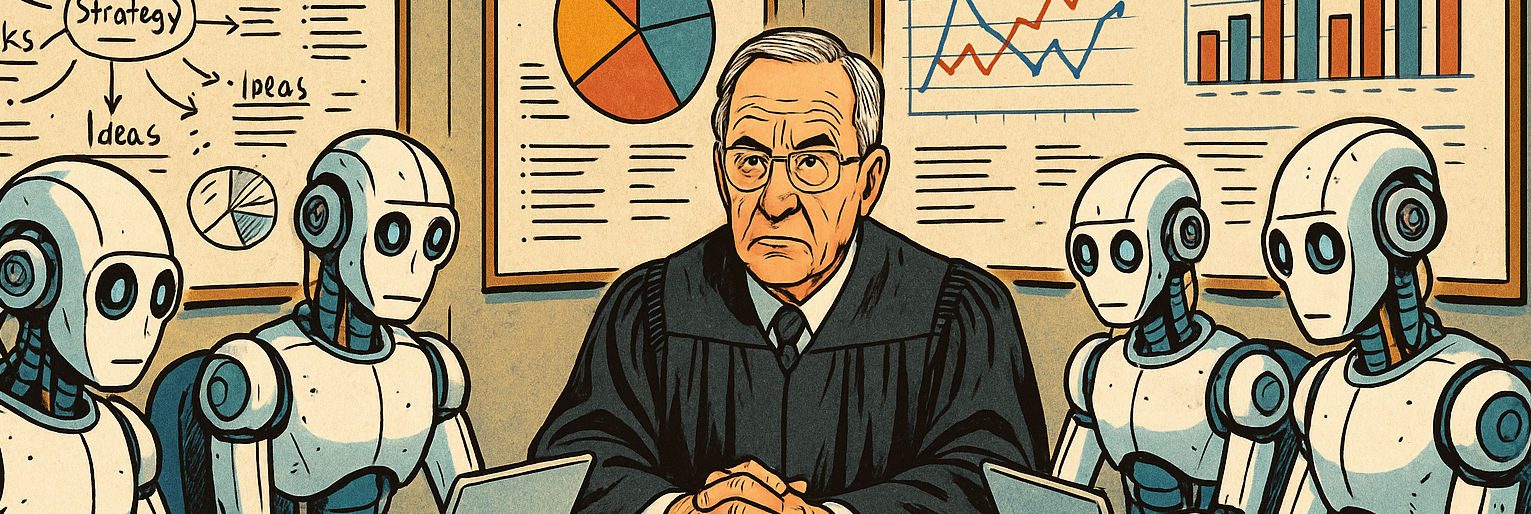
 Image generated with gpt4o
It’s Monday morning in a busy marketing department. A brand-new AI system has just automated campaign reporting, social media scheduling, and customer segmentation. The dashboards are immaculate, the workflows are faster, and the cost of running a campaign has dropped sharply. But by Wednesday, a problem arises: two automated ad segments clash, bidding against each other on the same keywords, inflating costs and cannibalizing leads.
No one on the team wrote the logic for what to do when two machine-driven tasks collide. The data scientist is on vacation. The AI tool only knows how to execute its narrow functions. Someone needs to step in, look at the broader picture, weigh priorities, and make a call on which campaign should win.
This moment—when the algorithm runs out of script—is where judgment shows its irreplaceable value.
The Core Question
Automation is advancing relentlessly. From legal contract review to financial auditing, from content creation to sales outreach, many of the once complex tasks of white-collar workers are now being executed by AI agents. It’s tempting to think this spells the end of many professional roles. Yet history suggests something different: when certain tasks are automated, new tasks—especially those requiring judgment, coordination, and ethical consideration—become even more important.
This article argues that judgment—the human capacity to interpret ambiguity, align actions with values, and arbitrate between conflicting goals—will be the critical differentiator and primary source of economic value in the next era of work.
Automation may replace tasks, but the cohesion of systems still depends on human oversight. Without judgment, even the best-automated pipelines risk breakdown. As David Autor notes, AI is less likely to eliminate jobs wholesale than to reconfigure them, shifting value to the “expert bottleneck” where humans must interpret or arbitrate the outputs of machines.
Task Automation Is Inevitable, but Incomplete
Automation thrives on structure. Any process that can be clearly defined, broken into repeatable steps, and measured against clear outputs is an ideal candidate for AI or robotic process automation (RPA). McKinsey’s 2025 report predicts that over 60% of white-collar job tasks can be at least partially automated in the next decade.
But the question is: is this a threat for white-collar workers?. Maybe, since automation is not the same as end-to-end replacement. As James Bessen points out in The New Goliaths, automation often increases the complexity of systems, creating “integration challenges” that require more—not less—human insight. Each new automated component adds potential for conflicts, misalignment, or “edge cases” the system cannot handle.
Consider a hospital scenario. Machine learning models may accurately predict patient readmission risks or suggest treatments. But when a high-risk patient refuses a treatment due to religious beliefs, the system cannot resolve this conflict on its own. A doctor must step in, balancing medical data, patient autonomy, and ethical implications.
In other words, automation is a tool for execution, not coordination. Coordination—deciding what should happen next when multiple automated outputs collide—is inherently a human domain, at least for now. In fact, we can see a signal of that nowadays where chatbots are widely used but still the labor market effects are quite small.
The Hidden Cost Curve of coordination
Coordination problems emerge when different automated tasks interact without a unifying logic. These problems can take several forms:
-
Temporal constraints – When multiple automated systems run asynchronously, creating bottlenecks or misaligned handoffs.
-
Informational constraints – When systems produce conflicting outputs or use incompatible data formats.
-
Normative constraints – When decisions require ethical, legal, or strategic interpretation that exceeds coded rules.
For example, an AI in customer support may prioritize response time over personalized care, while a marketing AI prioritizes upselling. Without human oversight, these two objectives can create customer frustration.
Research by the OECD (2025) notes that the economic value of human labor increasingly lies in resolving these frictions, particularly in sectors like finance, healthcare, and professional services This is the “judgment premium”: as tasks become automated, the ability to orchestrate them meaningfully becomes more valuable.
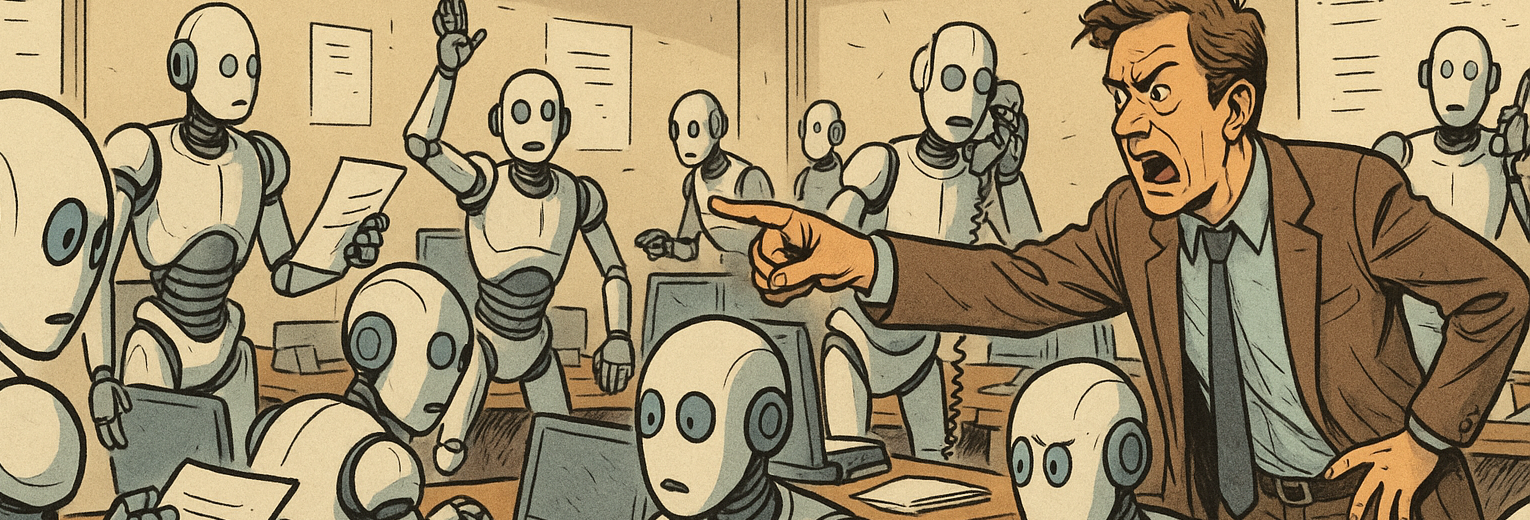 Image generated with gpt4o
What Exactly Is Judgment?
Judgment is not just decision-making. It is a multi-layered cognitive skill set that combines:
-
Contextual framing – Understanding the broader environment in which a decision sits, including history, culture, and strategic goals.
-
Value alignment – Weighing trade-offs not just on efficiency, but on fairness, ethics, and long-term impact.
-
Metacognitive calibration – Knowing when to trust data and when to challenge it, when to defer to automation and when to override it.
AI can excel at analyzing probabilities, but judgment involves reasoning under uncertainty with competing values, something even the most advanced models still struggle with (yet).
A vivid example can be found in financial auditing. AI tools can flag anomalies in transactions faster than humans ever could. But deciding whether a flagged pattern indicates fraud, error, or legitimate variance requires contextual knowledge of the business and its practices—something only a skilled auditor can provide.
Judgment versus Decision-Making
Judgment is the ability to make considered decisions or come to sensible conclusions by evaluating information, weighing alternatives, anticipating consequences, and applying experience, values, and context to choose the best course of action.
It typically involves:
- Interpretation of ambiguous or incomplete information
- Balancing competing priorities or values
- Applying ethical or strategic reasoning
- Adjusting to new or uncertain situations with prudence
Judgment differs from simple decision-making in that it requires nuance, discernment, and contextual understanding—qualities not easily reduced to rules or algorithms.
Judgment’s Complementary role has proven being an essential part of automated or AI enriched tasks. In these cases humans are still indispensable in the workflow:
-
*Healthcare: A study of AI-assisted diagnosis found that while algorithms can identify diseases with remarkable accuracy, doctors play a crucial role in evaluating trade-offs, like when to pursue an aggressive treatment versus palliative care Brynjolfsson et al., 2022.
-
*Legal and compliance: AI contract review tools can identify standard clauses and potential risks, but human lawyers must evaluate intent, precedent, and negotiation strategy, which remain inherently judgment-driven Autor, 2024.
-
*Corporate decision-making: Even the most advanced LLMs cannot fully interpret the political and social consequences of corporate decisions. As the RFBerlin Institute (2024) points out, executives are increasingly called to act as “narrative weavers,” connecting data-driven insights with human values IZA Institute of Labor Economics (2024)
Economic value
Automation shifts the locus of value creation. In the industrial age, value was tied to physical labor. In the digital age, it shifted to analytical capabilities. Now, as AI commoditizes analysis, judgment emerges as the scarce resource.
According to Autor workers who can integrate technical, strategic, and ethical perspectives will capture a growing “judgment wage premium.” This echoes the finding from OECD that tasks involving human oversight and arbitration will see growing demand, even as routine cognitive tasks decline.
Moreover, coordination problems scale non-linearly with automation. The more components in a system, the higher the number of potential failure points. This means that a relatively small number of professionals who can diagnose, interpret, and decide will wield outsize influence—and economic value.
Organizational Design for Judgment
How can companies harness this principle? Several strategies emerge:
-
Job re-bundling: Instead of splitting jobs into ever-narrower tasks (a hallmark of the industrial approach), organizations should bundle high-value tasks around judgment—for example, creating roles that combine technical literacy with strategic oversight.
-
Integrators: Firms like Google and Amazon use “integrators”—cross-functional roles that align automated pipelines with business objectives. These integrators are often the translators between automated logic and human priorities.
-
Tools for judgment amplification: Rather than replacing humans, AI should provide context dashboards, simulation environments, and counterfactual scenarios that empower humans to make better decisions.
If judgment is the differentiator, education and workforce training must pivot. Traditional curricula focus on technical skills or rote analysis. Tomorrow’s workers need:
-
Critical reasoning – The ability to question outputs rather than blindly trust them.
-
Ethical literacy – Understanding the societal implications of data-driven decisions.
-
Systems thinking – Seeing beyond silos, understanding how automated modules interact.
Public policy also needs to recognize that human oversight is not a cost center but a safeguard. Regulatory frameworks—especially in finance and healthcare—are starting to demand “human-in-the-loop” accountability precisely because judgment cannot yet be automated [OECD, 2025].
Does everybody agree to this thesis?
No thesis is bulletproof. Could AI eventually learn judgment? Some argue that advanced multi-agent systems combined with alignment breakthroughs might handle coordination and value trade-offs better than humans. Large Language Models (LLMs), with reinforcement learning and value alignment layers, are already approximating certain kinds of decision-making (e.g., content moderation, strategic planning).
Critics like Acemoglu and Restrepo (2021) warn that overestimating the human uniqueness of judgment could lead to complacency. If AI learns to simulate human value frameworks at scale, humans might be displaced even in high-level roles [Acemoglu & Restrepo, 2021].
There is also a practical challenge: judgment is hard to measure and reward. Firms often default to cost-cutting and quantifiable productivity, undervaluing the less tangible benefits of human oversight. Without deliberate effort, the “judgment premium” could remain unrecognized, leading to underinvestment in the very human capacities that keep systems reliable.
Wrap up: Humans as Narrative Weavers
Automation is inevitable, but irreducible ambiguity remains. When machines handle the “how,” humans must determine the “why.” The economic future doesn’t belong to those who can perform tasks faster than a machine; it belongs to those who can interpret, integrate, and arbitrate the outputs of machines into meaningful action.
Judgment is not a fallback skill; it is the core of professional value in an automated world. Like a conductor guiding an orchestra of autonomous instruments, human professionals will be valued for their ability to synthesize disparate automated components into coherent strategies.
Again as Autor puts it:
The challenge is not to beat the machine, but to become the mind that directs the machine
That’s the future of work, I guess. But the time will tell, the jury is still out (pun intended).
References
-
Autor, D. (2024). Applying AI to Rebuild Middle-Class Jobs. NBER Working Paper 32140.
-
Brynjolfsson, E., Li, D., & Raymond, L. (2022). Language Models and Labor Productivity. NBER 30957.
-
Humlum A. & Vestegaard E. (2025) Large Language Models, Small Labor Market Effects. NBER
-
McKinsey Digital (2025). AI in the Workplace: A Report for 2025.
-
TechTalks (2025). AI’s Human Bottleneck and Accountability Problem.
-
Acemoglu, D., & Restrepo, P. (2021). Harms of AI. MIT Economics Working Paper.